 Landlocked Fleet


- Date
- 7 December 1941
- Place
- Pearl Harbor, Oahu, Hawaii
- Attacking force
- Japanese carrier strike force under Chūichi Nagumo
- Aircraft over Oahu
- 353, in two waves
- American casualties
- 2,403 killed, 1,178 wounded
On Sunday 7 December 1941 the Empire of Japan attacked the U.S. Pacific Fleet at its base at Pearl Harbor on Oahu, Hawaii. The United States was still neutral. The air raid, launched from aircraft carriers, led the United States to declare war on Japan the next day.
Why Japan struck
Admiral Isoroku Yamamoto, commander of the Combined Fleet, planned the strike as a pre-emptive blow. The aim was to keep the Pacific Fleet from interfering with Japan’s planned advance into Southeast Asia. Japanese leaders also hoped to buy time and to shake American morale enough to bring a peace on Japanese terms.
The task force under Chūichi Nagumo left the Kuril Islands on 26 November with six aircraft carriers, two battleships, three cruisers, a screen of destroyers and eight oilers. The first aircraft were launched north of Oahu on the morning of 7 December.
The attack
The Opana Point radar picked up the incoming planes, but an officer at the Intercept Center presumed they were six B-17 bombers due from California. Other warnings were still being processed when the first bombs fell at 7:48 a.m. Hawaiian time.
A total of 353 Japanese aircraft reached Oahu in two waves. Slow torpedo bombers led the first and went for the battleships; dive bombers struck Hickam and Wheeler Fields. The second wave of 171 planes hit Bellows Field and Ford Island. Of the Navy’s 5-inch guns, none got into action. Ammunition lockers were locked and aircraft were parked wingtip to wingtip.
Ninety minutes after it began, the attack was over.
Air raid Pearl Harbor. This is not drill.
This became the famous message of the morning. It was sent from the headquarters of Patrol Wing Two, the first senior Hawaiian command to respond. The officer who sent it is not named in the record.
The fleet and the losses
All eight U.S. battleships present were damaged and four were sunk. Arizona was never raised and Oklahoma was raised but never repaired; the other six battleships returned to service during the war. Nearly half the American fatalities came from the explosion of Arizona’s forward magazine.
Total American losses were 2,403 killed and 1,178 wounded. In all, 188 of 402 aircraft in Hawaii were destroyed. Japanese losses were 29 aircraft, five midget submarines and 130 personnel. The three carriers of the Pacific Fleet were at sea, and the oil tanks and repair yards were left untouched. The Japanese would meet those carriers six months later at Midway.
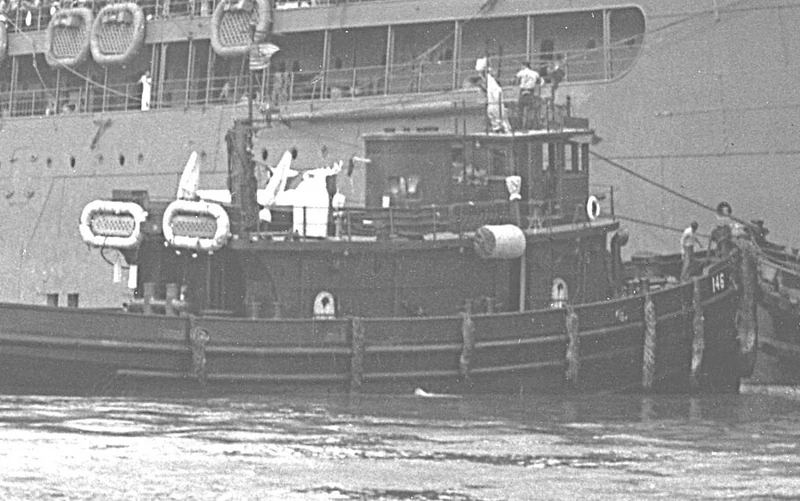
The tug Hoga at Pearl Harbor
The harbor tug Hoga (YT-146), now berthed in Arkansas, was moored near the drydocks when the attack began. She was under way within ten minutes of the first strike, picked up two men from the water and ran to the burning ships on Battleship Row.
Throwing lines to the damaged repair ship Vestal, she helped pull her away from Arizona at 8:30. She then went to the minelayer Oglala, and later with a second tug she pushed the burning battleship Nevada toward Hospital Point, where she settled by 10:45. Hoga stood at the battleship’s port bow, working on a fierce forecastle fire for over an hour.
She then fought fires on Maryland and Tennessee and finally on Arizona, from 16:00 on Sunday until 13:00 on Tuesday, 9 December. In all she fought the fires on Battleship Row for 72 hours. The rest of the week she patrolled the harbor, helped remove bodies and searched for Japanese submarines. In February 1942 Admiral Chester Nimitz commended her skipper, McManus, and the crew for efficient action and disregard of personal safety. The full story of the vessel is on the page for USS Hoga.
What came next
Roosevelt called 7 December a date which will live in infamy. The war ended in Tokyo Bay, and the surrender on USS Missouri is the other end of the story. Hoga and the submarine Razorback, both at the Arkansas Inland Maritime Museum, are often described as the bookends of the American war. Further battles are on the battles page.
Questions and answers
What time did the attack on Pearl Harbor begin?
At 7:48 a.m. Hawaiian time on 7 December 1941, with the attack on Kaneohe. The raid on the harbor itself followed within minutes and the whole attack lasted about ninety minutes.
Who sent the message Air raid Pearl Harbor. This is not drill?
The famous message was sent from the headquarters of Patrol Wing Two, the first senior Hawaiian command to respond.
How many Americans were killed at Pearl Harbor?
Published figures give 2,403 killed and 1,178 wounded. Of the dead, 2,008 were sailors, 218 soldiers and airmen, 109 Marines and 68 civilians.
Where were the American aircraft carriers?
At sea. The three carriers assigned to Pearl Harbor, Enterprise, Lexington and Saratoga, were absent, and the base's oil storage and repair facilities were not attacked.
What did the tug Hoga do at Pearl Harbor?
She was under way within ten minutes of the first strike, pulled the repair ship Vestal off Arizona, helped beach Nevada and fought fires on Arizona from Sunday afternoon until Tuesday, 9 December.
Where is Hoga today?
She is a museum ship at the Arkansas Inland Maritime Museum in North Little Rock, where she arrived on 23 November 2015.