 Landlocked Fleet

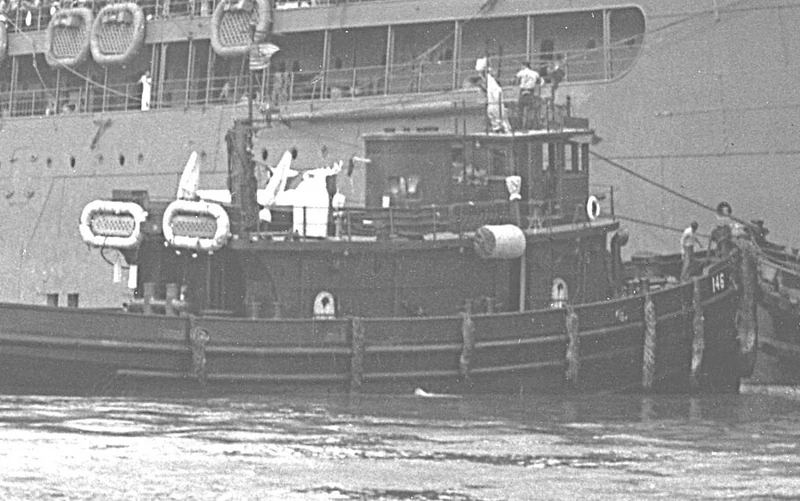
- Class
- Woban-class district harbor tug
- Builder
- Consolidated Shipbuilding Corporation, Morris Heights, New York
- Launched
- 31 December 1940
- In service
- 22 May 1941, Norfolk, Virginia
- Later names
- Port of Oakland, then City of Oakland (fireboat, 1948 to 1994)
- Landmark
- National Historic Landmark, 1989
- Today
- Museum ship, North Little Rock, Arkansas (since 23 November 2015)
USS Hoga is one of the last vessels afloat that were at Pearl Harbor on 7 December 1941. The Navy tug, hull number YT-146, was built in 1940 for ordinary yard work: shifting barges, easing ships into berths. On the morning of the attack that routine ended, and the record of Hoga at Pearl Harbor covers the 72 hours that followed. This page follows the history of the Pearl Harbor tug from her building through the attack and her second career in California to the berth she holds today.
The tug’s official name
Navy records call her Hoga, nothing more. She was placed in service in 1941 as a yard tug and was never commissioned as a warship, so the prefix in USS Hoga is a convention rather than part of her name. It is also the form most people use today. The name is a Sioux word for fish.
Building USS Hoga (YT-146) in 1940 and 1941
The tug was authorized on 18 June 1940 and built by the Consolidated Shipbuilding Corporation at Morris Heights, New York. Her keel was laid on 25 July and she was launched on 31 December 1940. She entered service at Norfolk, Virginia, on 22 May 1941 and was assigned to the 14th Naval District at Pearl Harbor. The trip took her through the Panama Canal, with stops at San Diego and San Pedro.
In Hawaii she was berthed at the Yard Craft Dock. Her work was moving cargo lighters and assisting ships in and out of berths. Like other yard tugs she carried firefighting equipment, a detail that mattered a few months later.
The Pearl Harbor tug on 7 December 1941, hour by hour
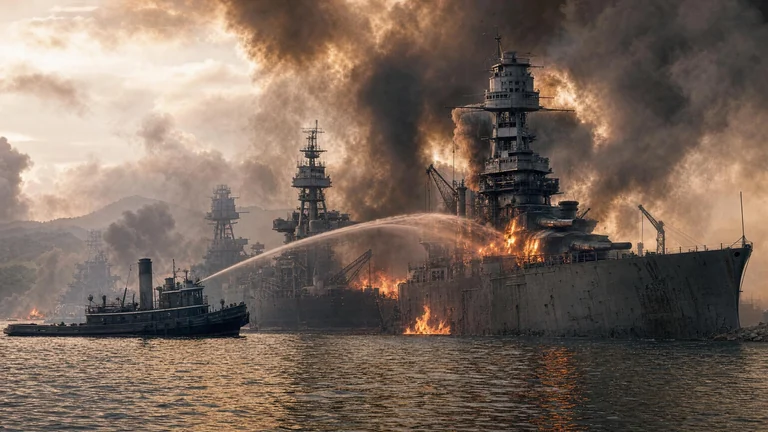
Hoga was moored with other yard craft near the drydocks at 1010 Dock when the Japanese aircraft struck, shortly before 8:00. She was underway within ten minutes. Steaming into the harbor she picked up two men from the water, put them on deck and went on toward the burning ships of Battleship Row.
At the end of the row lay Arizona, with the damaged repair ship Vestal moored alongside. Hoga threw lines to Vestal and helped pull her away from Arizona at 8:30. She then took in the tow lines that Vestal’s crew had chopped free and ran to the minelayer Oglala, flagship of Rear Admiral William Furlong, reaching her at 8:50. As Hoga arrived, the battleship Nevada passed her, making a run for the open sea.
Nevada had been hit by a torpedo at 8:03 and got underway at 8:45 with burning oil from Arizona spreading toward her. Bombs struck again at 9:07, and by 9:10 she was sinking and was grounded at Hospital Point so she would not block the channel. Meanwhile Hoga was moving the capsizing Oglala aft of the cruiser Helena, to clear Helena’s field of fire. Furlong, watching Nevada, sent the two tugs to nose her toward Hospital Point.
Hoga and the tug YT-130 pulled the battleship free and moved her to the western side of the harbor entrance, where she settled by 10:45. Hoga lay at her port bow, pouring water onto the burning deck and the wrecked forward section. With the pilothouse monitor and four hose lines she worked on a raging forecastle fire for more than an hour. The museum credits her with pushing Nevada out of the channel.
Seventy-two hours of firefighting
From Nevada, Hoga went back to Battleship Row and fought fires on Maryland, Tennessee and finally Arizona. She worked the Arizona fire from 16:00 on Sunday until 13:00 on Tuesday, 9 December. Her firefighting on Battleship Row is put at 72 hours in all.
She stayed on duty for the rest of the week, patrolling the harbor, helping to recover bodies and searching for Japanese submarines believed to be inside. In February 1942 Admiral Chester Nimitz commended her commanding officer, McManus, and his crew for efficient action and disregard of personal danger. For the wider attack, see the Pearl Harbor battle record. Through the war years Hoga kept clearing debris and supporting salvage. She was redesignated YTB, a large yard tug, on 15 May 1944.
Oakland fireboat years: Hoga’s history after the war
In 1948 the Navy lent her to the Port of Oakland, arranged through Congressman George P. Miller. Oakland had no municipal fireboat, and the port handled army cargo, oil tankers and a naval air station nearby. Transfer papers were signed on 28 May 1948. Alterations at Pacific Drydock and Repair, costing 73,000 dollars, raised her pumping capacity from 4,000 to 10,000 gallons a minute.
Renamed Port of Oakland and later City of Oakland, she entered service in July 1948 and was called out to a freighter fire the next day. Over 46 years she fought ship and waterfront fires, rescued people from the water, and on 3 July 1980 carried President Jimmy Carter on a tour of the port. She moved to Jack London Square on 7 December 1982. Her last major call was the burning tanker Puerto Rican outside the Golden Gate on 3 November 1984.
Landmark status and the move to North Little Rock
The tug was declared a National Historic Landmark in 1989. Oakland returned her to the Navy in 1994, and she went into the Suisun Bay Reserve Fleet. After years on offer for donation, the Navy chose North Little Rock from five applications, and the transfer contract was signed on 29 July 2005.
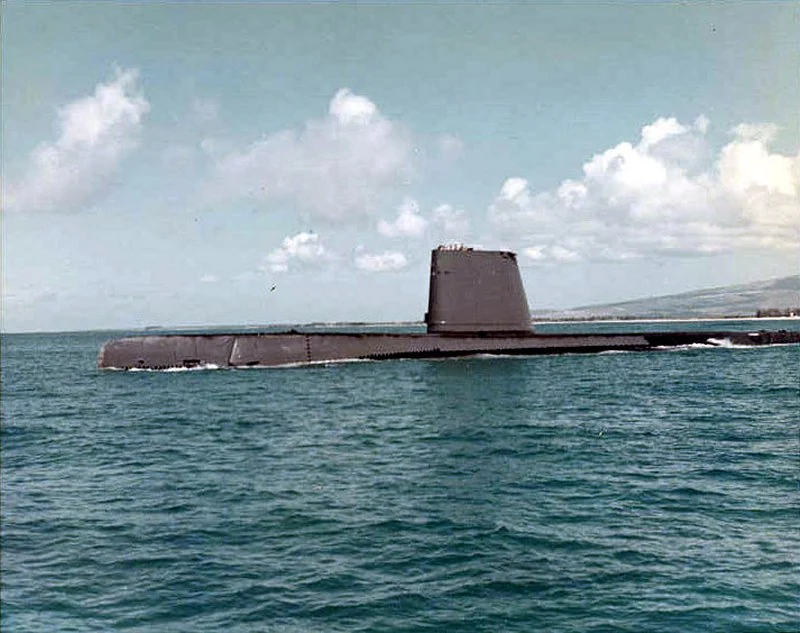
She stayed in Suisun Bay until 2012, then reached the Mare Island drydocks at Vallejo on 31 July to be made seaworthy. Hoga arrived at the Arkansas Inland Maritime Museum on 23 November 2015. She lies beside the submarine USS Razorback, which was in Tokyo Bay for the Japanese surrender, so Hoga at Pearl Harbor and Razorback in Tokyo Bay frame the Pacific war from its first morning to its last. The history of USS Hoga continues there as a museum vessel, and the Pearl Harbor tug can be seen from the river bank. The visitor guide covers the site.
Questions and answers
Is the tug's name USS Hoga?
Her official name is simply Hoga, with the designation YT-146. She was placed in service rather than commissioned as a warship, so the USS prefix is a matter of common usage.
What did Hoga do at Pearl Harbor?
She was underway within ten minutes of the first strike, helped pull the repair ship Vestal away from Arizona, towed the minelayer Oglala and then helped beach the battleship Nevada. She spent the following days fighting fires.
How long did Hoga fight fires after the attack?
She worked the fire on Arizona from 16:00 on Sunday 7 December until 13:00 on Tuesday 9 December. Her firefighting on Battleship Row is put at 72 hours in all.
Why was a Navy tug a fireboat in Oakland?
Oakland had no municipal fireboat. In 1948 the Navy lent Hoga to the Port of Oakland, which paid for alterations that raised her pumping capacity from 4,000 to 10,000 gallons a minute.
When did Hoga reach North Little Rock?
She arrived at the Arkansas Inland Maritime Museum on 23 November 2015, after work at Mare Island in California to make her fit for the journey.