 Landlocked Fleet

- Class
- Balao, later GUPPY IIA
- Builder
- Portsmouth Navy Yard, Kittery, Maine
- Launched
- 27 January 1944
- Commissioned
- 3 April 1944
- U.S. service
- 1944 to 1970
- Turkish service
- 1971 to 2001, as TCG Muratreis (S-336)
- Honors
- Five battle stars (World War II), four campaign stars (Vietnam)
- Today
- Museum ship, North Little Rock, Arkansas
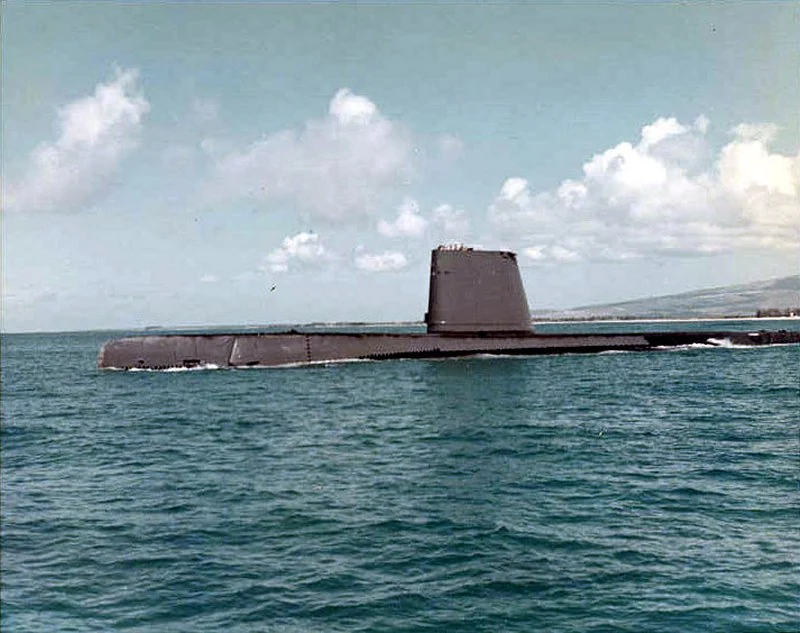
USS Razorback SS-394 is one of the longest-serving submarines still in existence. The Balao-class boat was built in 1943 and 1944, fought the last year of the Pacific war, was rebuilt for the Cold War, and then served the Turkish Navy until 2001. This page follows the history of the submarine from her launch to her berth at the Arkansas Inland Maritime Museum.
Building the submarine at Portsmouth
Razorback’s keel was laid at the Portsmouth Navy Yard in Kittery, Maine, on 9 September 1943. She was launched on 27 January 1944 and commissioned on 3 April 1944 under Lieutenant Commander A. M. Bontier.
Her career began badly. During shakedown exercises off New London in late April 1944 she ran aground on Race Point Ledge in Block Island Sound. A board of inquiry removed the captain, and Commander Roy S. Benson took over. After further training off New England the boat sailed for Pearl Harbor.
USS Razorback in World War II: five patrols
The first patrol began on 25 August 1944 east of Luzon, in support of the Palau landings. Razorback sighted only enemy aircraft and ended the patrol at Midway on 19 October.
The second was her most productive. Working with the submarines Trepang and Segundo in the Luzon Strait, she damaged the 6,933-ton freighter Kenjo Maru on 6 December and sank the old 820-ton destroyer Kuretake on 30 December 1944.
On the third patrol, in the East China Sea, she sank four wooden vessels in gun actions on the surface and brought three prisoners to Guam. The fourth was lifeguard duty off Japan: on 25 May 1945 she picked up a downed P-51 pilot, Lieutenant Colonel Charles E. Taylor, and on 5 June four crewmen of a B-29 shot down over Kobe.
The fifth patrol took her to the Sea of Okhotsk, where she sank six small wooden cargo craft. On 31 August 1945 she entered Tokyo Bay with eleven other submarines for the surrender ceremony. The patrols in detail are on their own page.
SS-394 after the war: the GUPPY IIA rebuild
Razorback stayed with the Pacific Fleet and operated off Japan and China in 1948 and 1949. In August 1952 she was taken out of commission to be rebuilt as a GUPPY IIA boat: a streamlined hull and sail, a snorkel and larger batteries for higher speed and endurance under water. She returned to service in January 1954. The page on the GUPPY conversion explains what changed.
From May 1954 she was based at San Diego. In 1957 she made a long patrol to the Far East that included surveillance of the Soviet port of Petropavlovsk. On 11 May 1962 she was submerged about two miles from the target when a destroyer fired a nuclear-armed anti-submarine rocket in the test known as Swordfish; the shock wave shook the boat.
In the 1960s she deployed regularly to the western Pacific and earned four campaign stars for Vietnam service. Her last American deployment ended on 7 August 1970.
A second history under the Turkish flag
On 30 November 1970 Razorback was decommissioned at Hunters Point and handed to Turkey. She was recommissioned on 17 December 1971 as TCG Muratreis (S-336), named for the Ottoman admiral Murat Reis, and served for another thirty years. Turkey decommissioned her on 8 August 2001. More on these years is on the page about TCG Muratreis.
From Turkey to the Arkansas River
The city of North Little Rock bought the boat on 25 March 2004 for 37,500 dollars; private donations covered the purchase and the tow. She left Turkey on 5 May, reached Key West on 13 June and New Orleans on 19 June.
The river leg was the difficult part. The Razorback submarine drew about 11.5 feet at the bow and nearly 15 feet at the stern, and parts of the Arkansas River were less than 9 feet deep. Two barges were used as pontoons to lift her a few feet while keeping her low enough to pass under the bridges. She reached her berth on 29 August 2004 and opened to visitors on 15 May 2005.
The submarine today
Today USS Razorback SS-394 lies at the Arkansas Inland Maritime Museum beside the harbor tug Hoga, a veteran of Pearl Harbor. Memorials to the lost submarines USS Snook and USS Scorpion stand on the same shore. Visitors can go aboard the Razorback submarine; practical details are on the visitor page. Her history continues in the pages on her patrols, her rebuild and her Turkish years.
Questions and answers
Is USS Razorback named after the University of Arkansas Razorbacks?
No. The submarine was named in 1943 after the razorback, a whale also called the fin whale. The link to Arkansas came sixty years later, when North Little Rock bought the boat and the state adopted her.
Is the submarine in North Little Rock called USS Arkansas?
No. The submarine on the Arkansas River is USS Razorback (SS-394). The ships named USS Arkansas were a battleship (BB-33) and a nuclear cruiser (CGN-41); the museum keeps relics of both ashore.
How many war patrols did USS Razorback make?
Five, between August 1944 and September 1945. She earned five battle stars for her World War II service.
Was Razorback really in Tokyo Bay for the surrender?
Yes. She entered Tokyo Bay on 31 August 1945 with eleven other submarines and was present when the surrender was signed aboard USS Missouri on 2 September. She left the next day.
How long did the submarine serve in total?
Fifty-six years on active duty under two flags: the U.S. Navy from 1944 to 1970 and the Turkish Navy, as TCG Muratreis, from 1971 to 2001.
How did a submarine get to Arkansas?
Under tow. She left Turkey on 5 May 2004, crossed the Mediterranean and the Atlantic, reached New Orleans on 19 June and was then towed up the Mississippi and Arkansas rivers, arriving on 29 August 2004.