 Landlocked Fleet

- Program
- Greater Underwater Propulsion Power Program (GUPPY)
- Variant
- GUPPY IIA (SCB 47C), 1952 to 1954
- Razorback decommissioned
- August 1952, for conversion
- Razorback recommissioned
- January 1954
- Balao boats converted to IIA
- Thirteen
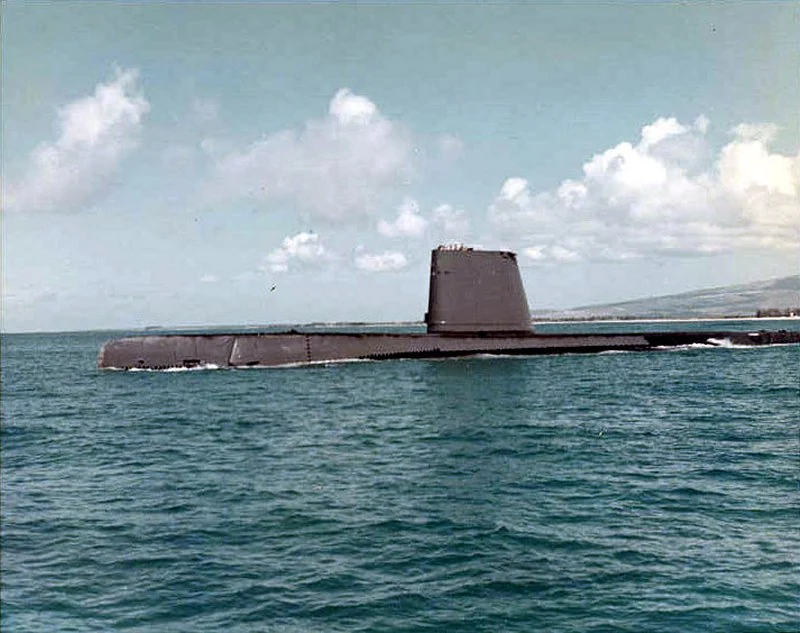
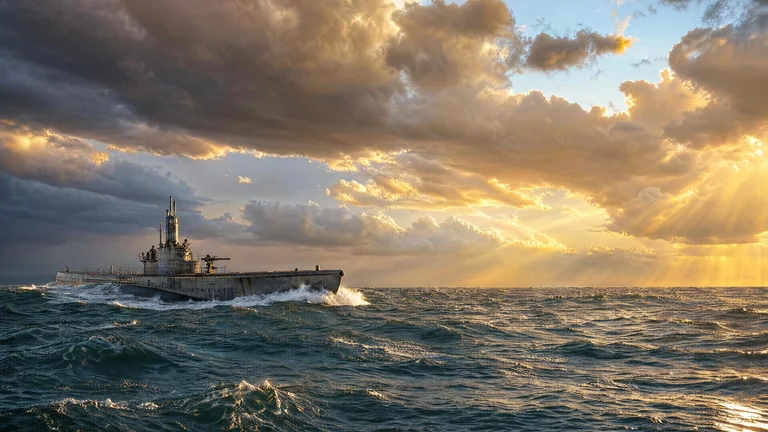
Razorback was built in 1943 and 1944 as a wartime fleet submarine, a boat designed to run on the surface and dive to attack. By 1952 that design was obsolete, and in a 1950s refit the navy rebuilt her. The Razorback GUPPY conversion turned a Balao-class hull into a faster, quieter and longer-lasting submerged boat, and it explains why the submarine in North Little Rock looks different from the wartime photographs.
The Greater Underwater Propulsion Power Program
The Greater Underwater Propulsion Power Program, GUPPY, was begun by the U.S. Navy after World War II. Its aim was to improve submerged speed, maneuverability and endurance. The final Y in the acronym was added for pronounceability.
The navy began by testing and reverse engineering two German Type XXI U-boats, U-2513 and U-3008, obtained as war reparation. That work produced four goals: more battery capacity, streamlined structures, snorkels and better fire control. The Bureau of Ships judged that existing Gato, Balao and Tench-class boats could be modified instead of waiting for a new class. The Chief of Naval Operations approved the project in June 1946.
A two-boat test program at Portsmouth grew into a series of conversions. They came in seven variants, in this order: GUPPY I, GUPPY II, GUPPY IA, Fleet Snorkel, GUPPY IIA, GUPPY IB and GUPPY III.
From prototypes to GUPPY IA
The prototypes, Odax and Pomodon, appeared in 1947. They lost their deck guns, got a streamlined bridge structure, and received a rounded bow in place of the sharp fleet-boat bow. After a conversion the faired structure around the conning tower and masts was called the sail.
Inside, the batteries changed most. The new Guppy battery used more, thinner plates to give higher current for longer, but it lasted 18 months against five years for the older Sargo battery and took longer to charge. Four 126-cell batteries went into enlarged wells that replaced storage, ammunition and refrigeration spaces. GUPPY II (1947 to 1951) added the snorkel.
The gain was large. Pomodon, the prototype, reached 17.8 knots surfaced and 18.2 knots submerged, against 20.25 knots surfaced and 8.75 knots submerged before conversion. The boat gave up some surface speed and more than doubled its underwater speed.
The cost was maintenance. The new batteries needed ventilation to remove hydrogen gas and cooling water to the terminals, and the interior was heavily rearranged to hold them. The new air conditioning system was of greatly increased capacity, and the lighting and other hotel loads were converted to 120-volt alternating current.
The 1951 GUPPY IA was a cheaper alternative. It kept the original battery wells and fitted four Sargo II batteries, and it moved the sonar room out of the forward torpedo room. Compared with GUPPY II it offered lower cost, better habitability and easier maintenance, at some cost to underwater performance.
What GUPPY IIA changed
GUPPY IIA, project SCB 47C, followed IA and was nearly identical to it. The difference was space. It removed one forward engine and put pumps and air conditioning machinery in its place, which relieved the cramped conditions of the earlier conversions.
Some boats also had their high-pressure air compressors moved to the lower level of the forward engine room. The freezer and refrigerator units went to the space under the galley, and the sonar room moved to the forward end of the pump room. Sargo II batteries went into the existing wells. From outside, a GUPPY IIA boat showed three diesel exhaust outlets where earlier conversions had four.
The 1950s refit: Razorback, 1952 to 1954
Not every wartime boat got the full treatment. The navy could not fund all the GUPPY conversions it wanted, so it devised the Fleet Snorkel Program as a minimum: a snorkel, a streamlined sail, bigger air conditioning and a stronger electrical system, but the original bow and batteries stayed. Twenty-three Balao boats received that upgrade, and their submerged performance was well below any GUPPY. Razorback was in the other group.
Razorback was one of thirteen Balao-class boats given the IIA upgrade in 1952 to 1954. She was decommissioned in August 1952 for the work and recommissioned in January 1954, so the Razorback GUPPY conversion kept her out of service for seventeen months. She then reported to Submarine Squadron 10 at New London, Connecticut, for shakedown and training.
No detailed account of her individual yard work has been published; she received the standard IIA package described above, the same 1950s refit given to her sister boats. On 24 May 1954 she joined Submarine Squadron 3 at San Diego, where her Cold War service began.
What the Razorback GUPPY conversion meant for the boat
For crew and visitors the main effects of the Razorback GUPPY conversion were the rounded hull lines, the streamlined sail and the revised interior. The wartime patrols described on the war patrols page were made in the earlier configuration. Later GUPPY III boats, rebuilt in 1959 to 1963, were cut open and lengthened by 12.5 or 15 feet for new berthing and sonar space; Razorback was not among them. Living arrangements aboard are the subject of the page on sleeping quarters, and the overall history is on the main USS Razorback record.
Questions and answers
What does GUPPY stand for?
Greater Underwater Propulsion Power. The final Y was added to make the acronym pronounceable. The program was started by the U.S. Navy after World War II to improve the submerged speed, maneuverability and endurance of its submarines.
When was Razorback converted to GUPPY IIA?
She was decommissioned in August 1952 for the conversion and recommissioned in January 1954. The GUPPY IIA program as a whole ran from 1952 to 1954.
How did GUPPY IIA differ from earlier conversions?
It was nearly identical to GUPPY IA but removed one forward engine to relieve overcrowding, replacing it with pumps and air conditioning machinery. Externally it had three diesel exhaust outlets instead of four.
Where did the GUPPY idea come from?
From the German Type XXI U-boats U-2513 and U-3008, which the navy obtained as war reparation, tested and reverse engineered.
How many Balao-class boats became GUPPY IIA?
Thirteen: Bang, Diodon, Entemedor, Hardhead, Jallao, Menhaden, Picuda, Pomfret, Razorback, Ronquil, Sea Fox, Stickleback and Threadfin.
Did Razorback get a lengthened hull?
No. The lengthened hulls belong to GUPPY III, a later program of 1959 to 1963 that did not include Razorback.