 Landlocked Fleet


- Boat
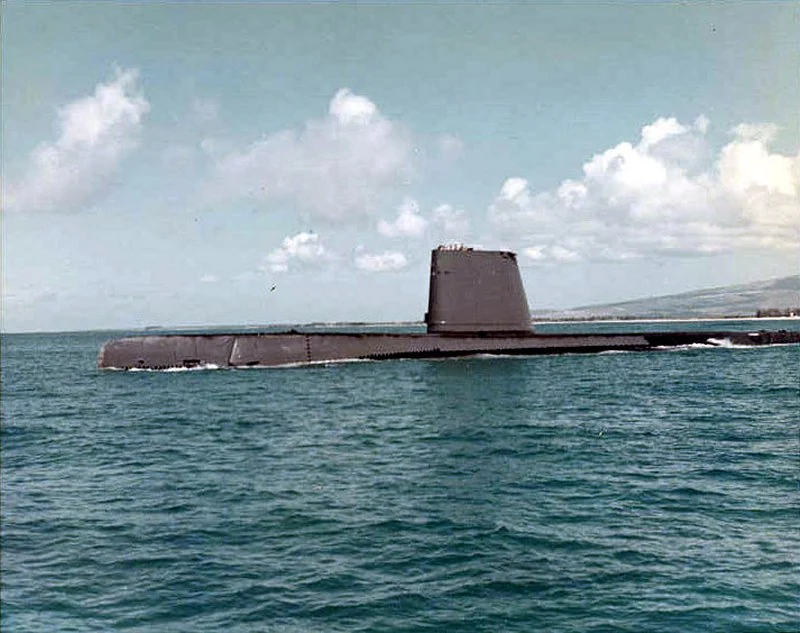
- USS Razorback (SS-394), Balao class
- Patrols
- Five, 25 August 1944 to September 1945
- Ships sunk
- One destroyer, plus small wooden craft in gun actions
- Rescues
- One fighter pilot and four bomber crewmen
- Honors
- Five battle stars for World War II
USS Razorback (SS-394) reached the Pacific late. She was commissioned on 3 April 1944, and her first war patrol began only on 25 August, after a grounding in training and a transit to Pearl Harbor. In the twelve months that followed she made five patrols, and two of them were spent mostly on rescue work rather than attack. This page follows each one in order.
Before the first patrol
Razorback was a Balao-class boat, a design with thicker pressure-hull steel than the Gato class and a test depth of 400 feet. Her first weeks were rough. In late April 1944, during shakedown exercises off New London, she ran aground on Race Point Ledge in Block Island Sound. A board of inquiry removed the captain, and Commander Roy S. Benson took command. The executive officer, Lieutenant Commander Haynes, was replaced by Lieutenant Commander C. Donald Brown.
After more training off New England the boat sailed for Pearl Harbor.
First patrol: east of Luzon
The first patrol started on 25 August 1944. Razorback worked east of Luzon as a member of an offensive group, in support of the Palau landings of mid-September. The only contacts were enemy anti-submarine aircraft. She turned north-east and reached Midway Island on 19 October without an attack.
Second patrol: the Luzon Strait
Razorback left Midway on 15 November 1944 with Trepang and Segundo and hunted in the Luzon Strait. On 6 December she damaged the 6,933-ton freighter Kenjo Maru. On 30 December she sank the old destroyer Kuretake, 820 tons, and damaged another freighter. She reached Guam for refit on 5 January 1945.
This was the only patrol in which she sank a warship.
Third patrol: the East China Sea
On 1 February 1945 Razorback set out again, this time with Segundo and Sea Cat, bound for the East China Sea. She sank four wooden ships in three separate surface gun actions. She also landed three Japanese prisoners at Guam before the patrol ended at Pearl Harbor on 26 March.
Fourth patrol: lifeguard duty off Japan
On 7 May 1945 the boat headed west again, assigned to lifeguard duty in the Nanpo Islands and Tokyo Bay areas.
Razorback rescued Lieutenant Colonel Charles E. Taylor, a P-51 fighter pilot of the 21st Fighter Group, on 25 May. On 5 June she picked up four B-29 Superfortress crewmen shot down in an air raid on Kobe. She returned to Midway to end the patrol and refit on 27 June.
Fifth patrol: the Sea of Okhotsk and Tokyo Bay
Razorback left Midway on 22 July 1945 for the Sea of Okhotsk. In one surface gun action she sank six wooden cargo craft, the small boats the Japanese navy used for front-line logistics, and damaged two more. She spent the rest of the patrol on lifeguard station off Paramushiro for aircraft flying from Alaska.
On 31 August she entered Tokyo Bay with eleven other submarines to take part in the formal surrender. The instrument was signed on the deck of USS Missouri just after 09:00 on 2 September 1945; the full account is on the page about the Tokyo Bay surrender. Razorback departed on 3 September, arrived at Pearl Harbor on 11 September and reached San Diego on 20 September.
What the record shows
Razorback’s war was modest in tonnage and varied in work: a destroyer, a string of small wooden craft, prisoners, and five airmen brought home. Her five battle stars came from this service. Original patrol reports of this kind are discussed in the library guide. The rebuild that followed the war is covered in the GUPPY conversion page, and the overview of the boat is on the main USS Razorback record.
Questions and answers
How many war patrols did USS Razorback make in World War II?
Five. The first began on 25 August 1944 and the fifth ended with her arrival at Pearl Harbor on 11 September 1945. She earned five battle stars for the war.
What did Razorback sink on her war patrols?
The old destroyer Kuretake, 820 tons, on 30 December 1944, four wooden vessels on the third patrol and six wooden cargo craft on the fifth. She also damaged the freighter Kenjo Maru.
Whom did Razorback rescue during her lifeguard duty?
On 25 May 1945 she picked up Lieutenant Colonel Charles E. Taylor, a P-51 pilot of the 21st Fighter Group. On 5 June she rescued four crewmen of a B-29 shot down over Kobe.
Which submarines patrolled with Razorback?
Trepang and Segundo on the second patrol, and Segundo and Sea Cat on the third. On the first she was part of an offensive group supporting the Palau landings.
Was Razorback at the Japanese surrender?
Yes. She entered Tokyo Bay on 31 August 1945 with eleven other submarines. The surrender was signed aboard USS Missouri on 2 September, and she left on 3 September.